
⚡ Quick Key Takeaways
- Hall Effect (HE) Magnetic Sensors: Replaces physical metallic contact pins with magnetic flux measurement, enabling 0.1mm actuation precision.
- Rapid Trigger Technology: De-actuates keys the instant your finger lifts upward by 0.1mm, eliminating counter-strafe movement lag.
- Dual-Action Keys: Bind light keypresses to walking and deep keypresses to sprinting on a single physical key.
- Acoustics & Mounts: Aluminum CNC gasket mounting with IXPE switch pads and PORON dampening foam yields a deep, solid acoustic sound profile.
In 2026, the mechanical keyboard industry underwent its single largest paradigm shift since the expiration of the original Cherry MX patents. Traditional mechanical switches—which rely on physical copper leaf contact points—are rapidly being replaced in gaming setups by Hall Effect (HE) magnetic switches. Whether you are executing split-second evasive maneuvers in Once Human Stardust Raids or perfecting elemental combos in Neverness to Everness, magnetic actuation offers unprecedented responsiveness.
1. How Hall Effect Magnetic Sensors Work
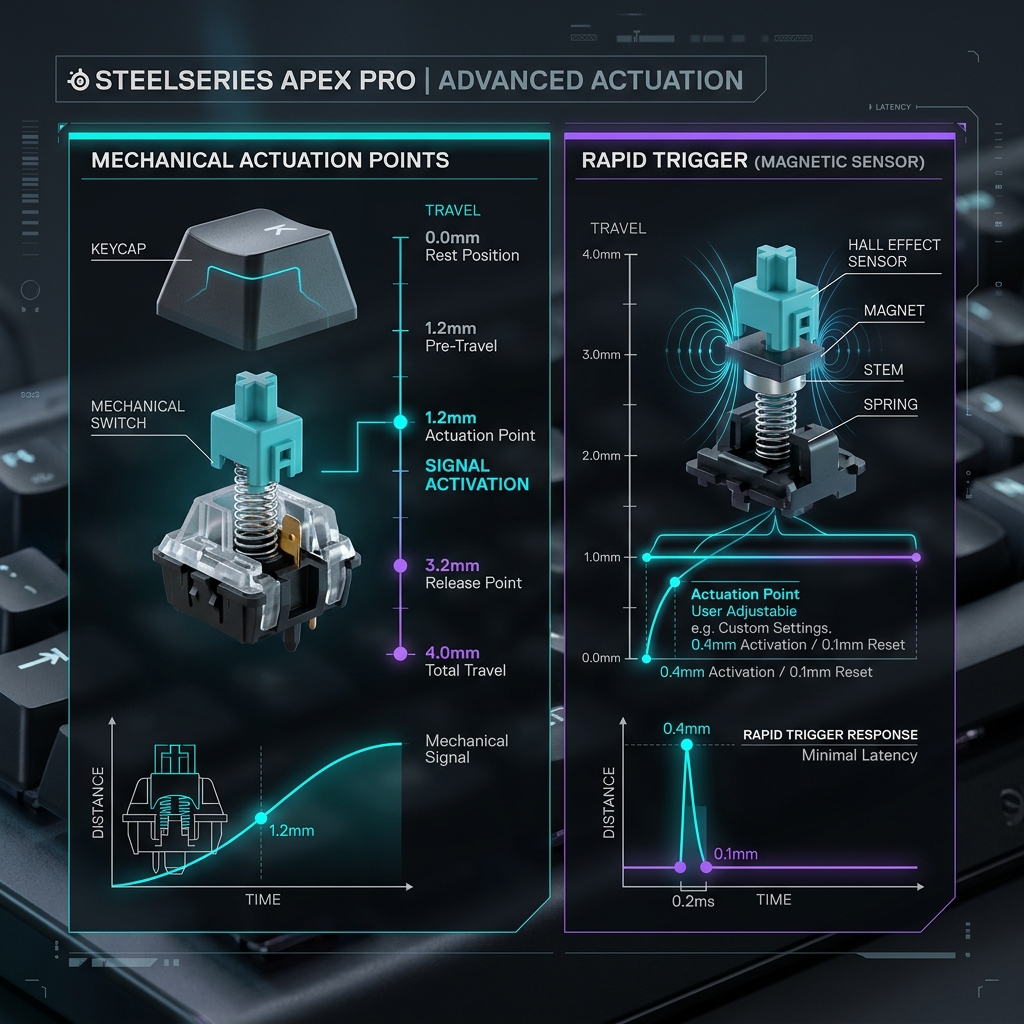
Traditional mechanical switches operate on a binary physical circuit. When a key is pressed down, a stem pushes two metallic leaves together to close an electric circuit at a fixed height (typically 2.0mm). Once triggered, the key must travel back up past a fixed reset height (usually 1.5mm to 1.8mm) before it can be pressed again. This mechanical hysteresis introduces inherent movement latency during rapid tapping.
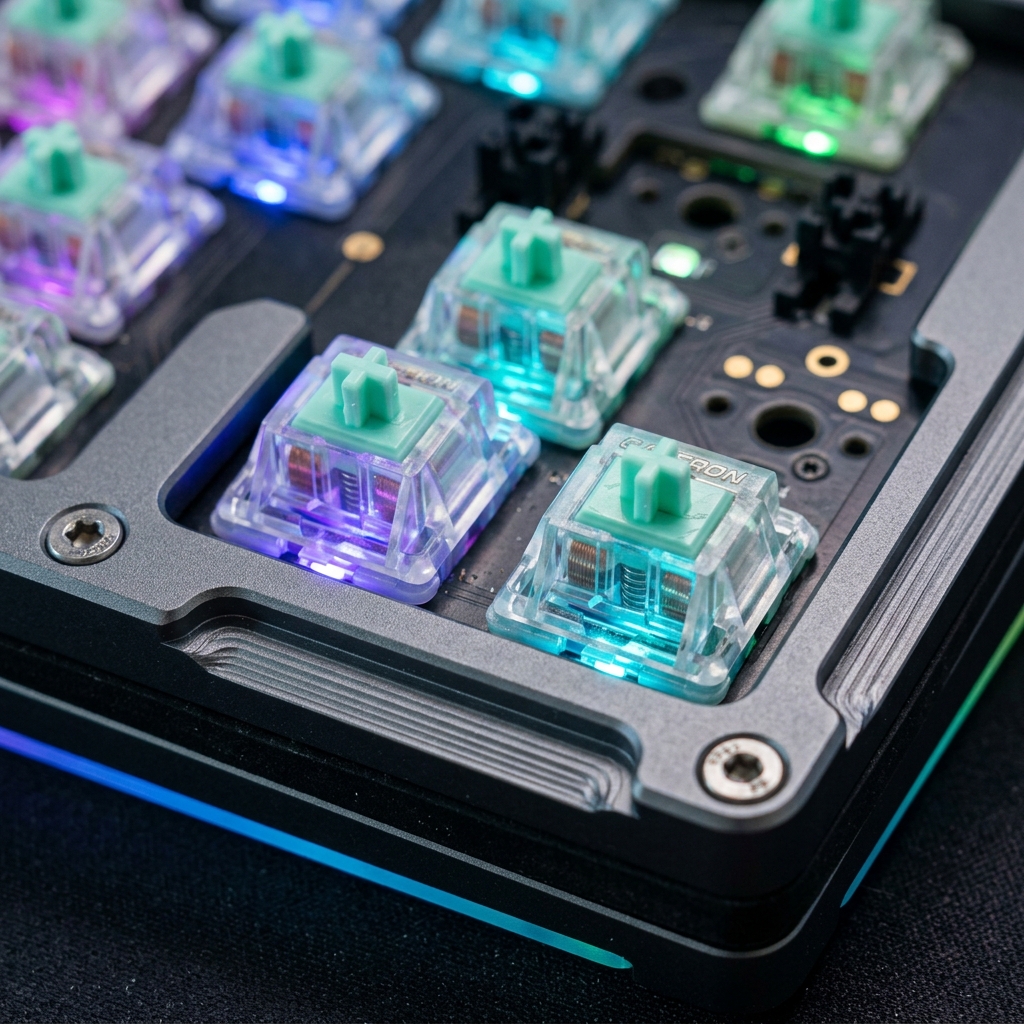
Hall Effect (HE) switches eliminate metal contacts entirely. Inside each switch, a permanent magnet is mounted inside the stem, while a Hall Effect sensor on the keyboard PCB measures the exact strength of the magnetic field in real time. As you depress the key, the sensor calculates the exact vertical position of the stem with sub-millimeter precision (down to 0.01mm resolution).
Traditional Mechanical vs. Magnetic Hall Effect
Because magnetic sensors track continuous voltage changes rather than physical contacts, software can dynamically alter key behavior without replacing hardware switches.
Traditional Mechanical
- Fixed 2.0mm Actuation Point
- Fixed 1.5mm Reset Distance
- Debounce Delay Required (5ms - 15ms)
- Physical Leaf Contact Wear
Magnetic Hall Effect (HE)
- Dynamic 0.1mm - 4.0mm Actuation
- Instant 0.1mm Rapid Trigger Reset
- Zero Debounce Delay (0.1ms Latency)
- 100 Million+ Frictionless Clicks
2. Understanding Rapid Trigger Technology
The headline feature of magnetic Hall Effect keyboards is Rapid Trigger. With traditional switches, if you want to stop moving or quickly double-tap a key (e.g. strafing left and right to dodge boss attacks), you must lift your finger past the fixed reset point before re-engaging.
With Rapid Trigger enabled, actuation and reset points become dynamic. The instant the keyboard detects that your key stem has traveled upward by a micro-distance (e.g. 0.1mm), the key de-actuates immediately. The moment you push down by 0.1mm again, the key re-actuates. You do not need to wait for the key stem to travel back to the top of its housing.
3. Key Specs & Switch Architecture Comparison
When selecting a modern custom mechanical keyboard, switch stem stability, housing material (PC vs. POM), and magnetic sensor quality dictate both acoustic feel and tracking consistency.
2026 Switch Technology Benchmark Matrix
| Switch Technology | Input Latency | Actuation Adjustability | Acoustic Sound Profile | Best Suited For |
|---|---|---|---|---|
| Magnetic Hall Effect (HE) | 0.125 ms | 0.1mm – 4.0mm (Per-Key) | Thocky / Solid Deep Pitch | Competitive Esports & Action RPGs |
| Optical Analog | 0.25 ms | 0.2mm – 3.8mm | Clacky / Higher Pitch | Racing Sims & Flight Controls |
| Traditional Mechanical Linear | 2.5 ms – 8.0 ms | Fixed (2.0mm) | Customizable / Deep Thock | Daily Typing & General Gaming |
| Tactile / Clicky Mechanical | 5.0 ms – 12.0 ms | Fixed (1.8mm – 2.2mm) | Loud Sharp Click | Pure Typing Enthusiasts |
4. Keycap Profiles, Acoustics & Gasket Mounting
Performance means little if the typing experience feels hollow or uncomfortable. 2026 custom gaming keyboards incorporate multi-layer acoustic insulation:
- CNC Aluminum Cases: Heavy solid aluminum alloy bases eliminate board flex and provide a grounded acoustic base.
- Gasket Mount Architecture: The PCB plate is suspended using silicone or PORON foam gaskets, offering flex cushioning that reduces finger fatigue during 6-hour gaming marathons.
- Double-Shot PBT Keycaps: Unlike cheap ABS plastic keycaps that turn shiny and greasy over time, double-shot PBT keycaps feature textured surfaces and non-fading legend lettering.
- IXPE Switch Pads & PORON Dampening: Internal foam layers absorb high-frequency pinging, resulting in a rich, satisfying "thock" sound on every keystroke.
Explore Full Setup Optimization
Pair your Hall Effect keyboard with ultra-lightweight 8K wireless mice and high-refresh OLED displays.
Read Top PC Gaming Hardware Buyer's Guide 2026 →